About us
Foreign Language Voices
Studio
Contacts
FAQ
Testimonials
Clients Area
e-mail me

  Voice Over rates  


English Portuguese Chinese  French  Italian     

F.A.Q.


What are your voiceover rates?

Voiceover rates differ depending on the application, length of use, and the number of words, pages or minutes. Please request a
custom quote by giving us a description of your job, when you need it delivered, and any special information you think we should know, and we will contact you with a quote within 24 hours.


How long are your quotes valid?

Every quote is valid for 30 days from issuance when involving our partners or other outside sources. If your project is completely an in-house project, we will honor our quote for 60 days.


What is your turnaround time?

Small projects often have a 24 hour or shorter turnaround time.
Contact us and let us know what you need.


Do you guarantee your work?

Your satisfaction is our goal. From developing a custom quote based on your project's unique parameters, to sending samples of our work in progress to you along the way, we are committed to getting the job done right, on time, and in budget.

We know from experience that
happy clients are repeat clients. So we work hard to find out in advance exactly what you are expecting before we begin recording. If within 30 days of receipt of the finished voiceover recordings you notify us of any discrepancies or are otherwise not satisfied with our work, we will correct any errors, noise, or direction problems at no cost to you.


How do you deliver the finished audio files? What file format do you use?

We deliver the finished audio files via email or FTP upload -- your choice.

As for file format, wav, aiff and mp3 are the most common. Some There are at least 200 formats available, so if it's an unusual format we may need to know what codec you are using in order to guarantee compatibility. But we'll figure out how to do it, and get it to you in the format you need.


For a voiceover job that includes translation, why is your quote only an estimate?

Word length and sentence construction vary greatly from language to language. You should expect the translated version of an English document to be approximately 15-25% longer in Portuguese, for example. While this will not affect your translation costs because we base our fees on the source language, this means that we will not have a final word count or time estimate for your foreign-language recording until the translation is complete. At that time, we will send you an updated invoice and you will have the opportunity to review the cost of your project. This awareness should help you plan your timeline and budget more accurately.

When translating from English, please budget for a possible increase in word count in the target language according to the following percentages:


PORTUGUESE/SPANISH


FRENCH


ITALIAN


GERMAN


15-25%


25%


25%


0-10%


In what languages can you handle voiceover recordings? How do you guarantee the accuracy of a recording in a language you do not speak?

We can record voiceover in almost any language. We have a huge pool of voice talent to choose from in more than 40 languages. With your approval, we will hold a casting session and identify the best voice in your requested language. For intricate and larger projects we will cast and hire a language director, a bilingual native speaker of your target language who will direct the talent as our liason during the recording session. 


European Portuguese or Brazilian Portuguese? 

Roughly speaking, the differences between European Portuguese and standard Brazilian Portuguese are comparable to the ones found between British and American English.

Today it is one of the world's major languages, ranked seventh
according to number of native speakers (between 205 and 230 million).

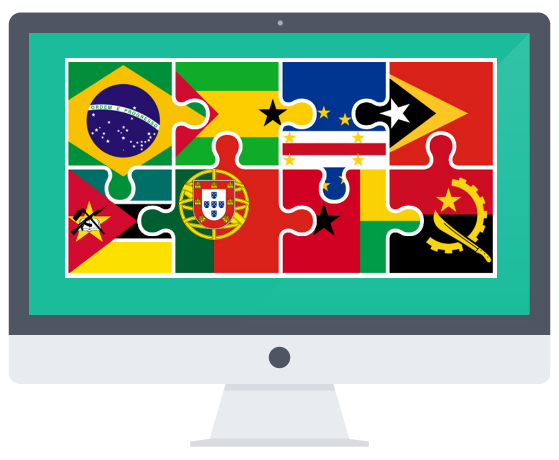
Portuguese is the official language of Angola, Brazil (190.6 million), Cape Verde, Guinea-Bissau, Portugal (10.6 million), São Tomé and Príncipe and Mozambique. It is also one of the official languages of East Timor (with Tetum) and the Chinese special administrative region of Macau (with Chinese).

Small Portuguese-speaking communities subsist in former overseas colonies of Portugal such as Macau, where it is spoken by 7% of the population, and East Timor (13.6%).

It is also spoken by substantial immigrant communities, though not official, in Andorra, Australia,France, Luxembourg, Jersey (with a statistically significant Portuguese-speaking community of approximately 10,000 people), Paraguay, Namibia, South Africa, Switzerland, Venezuela, Japan and the U.S. states of California, Connecticut, Florida, Massachusetts, New Jersey,New York and Rhode Island. In some parts of India, such as Goa and Daman and Diu,Portuguese is still spoken. There are also significant populations of Portuguese speakers in Canada (mainly concentrated in and around Toronto and Montreal), Bermuda and the Netherlands Antilles.

Portuguese is an official language of several international organizations. The Community of Portuguese Language Countries(with the Portuguese acronym CPLP) consists of the eight independent countries that have Portuguese as an official language. It is also an official language of the European Union, accounting for 3% of its population, Mercosul, the Organization of American States, the Organization of Ibero-American States, the Union of South American Nations, and the African Union (one of the working languages) and one of the official languages of other organizations.

The Portuguese language is gaining popularity in Africa, Asia, and South America as a second language for study.